
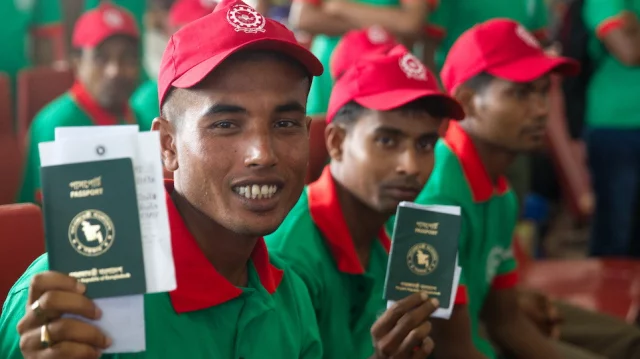
Driven by the severe macroeconomic risks of relying on a single labor corridor, Bangladesh is aggressively pivoting to redraw its overseas employment map. The Ministry of Expatriates’ Welfare and Overseas Employment has initiated formal overtures to at least 16 countries across Asia, Europe, and Africa, aiming to shatter the Middle East’s near-total monopoly on Bangladeshi migrant workers.
The Gulf Trap Currently, the demographic and economic concentration is dangerously one-sided. Between 70 to 75 percent of the nation’s migrant workforce is deployed in just six Gulf states, with Saudi Arabia alone absorbing a massive 33 percent. Crucially, this singular region dictates over 60 percent of Bangladesh’s total remittance inflows.
Policymakers acknowledge that this heavy dependence leaves the national economy highly vulnerable to Middle Eastern geopolitical shocks, regional economic slowdowns, or sudden policy shifts.
The Diversification Blueprint To cast a wider net, Dhaka has dispatched draft Memorandums of Understanding (MoUs) to a diverse portfolio of nations, including Serbia, Romania, North Macedonia, Malta, Portugal, Spain, Mauritius, Lebanon, Thailand, Oman, Austria, Albania, and Cambodia.
“If agreements are signed, we can formally request demand letters for workers,” Md Shahidul Islam Chowdhury, Joint Secretary at the Employment Wing of the Expatriates’ Ministry, stated. He confirmed that an MoU targeting the Thai market has already cleared legal vetting and received high-level approval, with Dhaka now awaiting Bangkok’s response.
The European Bottleneck Despite the strategic push, infiltrating the high-yield European market remains a severe bureaucratic hurdle. Bangladeshi migrants currently constitute a negligible 5 to 7 percent of the labor share in Europe.
Unlike Gulf nations that readily issue bulk demand letters, European countries enforce stringent entry barriers, including high skill requirements, language proficiency, and strict compliance standards. Often, access is conditional upon Dhaka accepting the repatriation of undocumented migrants.
Speaking exclusively to Sangbad24, Md Mosharraf Hossain, Director General of the Western Europe and EU Wing at the Ministry of Foreign Affairs, confirmed ongoing diplomatic efforts through foreign missions.
“We are conducting our diplomatic activities. Last year, a memorandum of understanding was signed with Italy,” Hossain told Sangbad24. “However, European labor markets operate differently from the Middle East. They do not typically issue demand letters on request, and often attach conditions such as the repatriation of undocumented migrants. We are continuing our efforts.”
Paperwork vs. Reality Industry veterans remain fiercely skeptical of the government’s approach, warning that simply signing documents will not unlock European borders.
- Strategic Engagement Needed: Fakhrul Islam, former leader of the Bangladesh Association of International Recruiting Agencies (BAIRA), argued that diplomacy must extend beyond mere paperwork. “Delegations need to visit, engage employers, and follow through consistently. Otherwise, these deals will just remain on paper.”
- The Skill Gap: Migration experts emphasize that without radically upgrading workforce skills and ensuring transparent recruitment frameworks, Bangladesh will rapidly lose ground to competitors in these emerging markets.
- Accountability Deficit: Shakirul Islam, Chairman of the Ovibashi Karmi Unnayan Program (OKAP), bluntly noted that previous diversification initiatives often stalled despite heavy expenditure, with zero accountability for the failures.
While diversifying migration routes is no longer an option but a macroeconomic necessity, the success of this pivot will hinge entirely on actionable diplomacy and the aggressive upskilling of the labor force, rather than just the exchange of draft agreements.









+ There are no comments
Add yours