

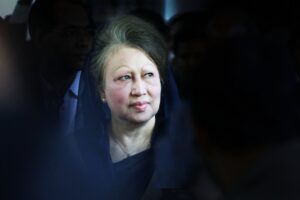
On 30 May 1981, when President Ziaur Rahman was assassinated in Chattogram, Khaleda Zia was not a politician, nor an aspirant, nor a public figure. She was a quiet homemaker inside Dhaka Cantonment, raising two young sons and living a life far removed from the roiling currents of national politics.
Her world changed in an instant.
Zia’s assassination shattered not only a family but a party. The BNP, still young and fragile, plunged into confusion. Leaders were divided, distrustful of one another, and terrified that without a steady hand, the party would collapse. At the centre of the crisis stood an ageing, reluctant acting president—Justice Abdus Sattar, nearly 80, soft-spoken, and perceived as politically frail. He was the military’s preferred figure: unthreatening, malleable, safe.
But the one name that unsettled the powerful was Khaleda Zia.
In his memoir, Moudud Ahmed wrote that the military establishment’s greatest fear was this quiet widow who had never sought political life. Ironically, her very reluctance made her formidable: she represented legitimacy, continuity, and Ziaur Rahman’s unspent political capital. If she wanted to lead, no one else could realistically stand in her way.
Yet, Khaleda was deeply resistant. Zia’s violent death had scarred her; politics seemed like a treacherous path that consumed lives and crushed families. Her own family discouraged her from entering public life. She had always avoided the political limelight: even when married to the president, she kept to herself, busy raising Tarique and Koko.
But the BNP’s crisis kept tightening around her. Senior leaders pleaded: without her, the party would fracture beyond repair.
Their appeal was strategic, not emotional. In a landscape increasingly shaped by military ambition, they believed only Zia’s widow could keep the BNP together.
Slowly, reluctantly, she stepped forward.
A reluctant first step
In January 1982, Khaleda formally joined the BNP as a primary member. Later that year, she delivered her first public address at her husband’s mausoleum.
She was soft-spoken, cautious, and visibly uncomfortable with the public gaze. But her presence electrified a party desperate for unity.
As tensions grew between the BNP and the military, factions within the party split over who should hold the chairmanship—Khaleda or President Sattar. The tug-of-war was so intense that Sattar personally visited her home twice, urging her to accept a ceremonial position and step aside. She declined politely. Eventually, after long internal negotiations, she withdrew her candidacy to avoid a party rift.
A coup, a crisis, and an unexpected rise
In March 1982, General Ershad deposed President Sattar in a military coup. With Sattar sidelined and the party rudderless, Khaleda’s influence grew rapidly. By early 1983, she had become BNP’s senior vice-chairperson; within months, she was the acting chairperson.
Her evolution was swift, dramatic, and to many, astonishing.
This once-shy woman now spoke in rallies, mobilised cadres, and confronted a military regime. Her calm resolve and refusal to be intimidated turned her into a symbol of civilian defiance. Even leaders from other opposition parties — Haider Akbar Khan Rono and Rashed Khan Menon — visited her cantonment residence, urging her to lead the broader anti-Ershad movement.
By 1984, she was the elected chairperson of BNP despite fierce opposition from military officials, intelligence agencies, and even members of the ruling cabinet. As Moudud Ahmed recalled, her leadership was so unwelcome to the establishment that it was hard to persuade Sattar to sign her nomination papers.
But Khaleda persisted.
From quiet home to national challenger
Throughout the 1980s, Khaleda became one of the most visible faces of resistance against General Ershad’s military rule. She was arrested multiple times, but each detention only amplified her symbolic power. In a deeply patriarchal political environment, her courage unsettled both allies and adversaries: she did not shout, she did not grandstand, yet she refused to bend.
Her resolve turned her into something rare in South Asian politics: a woman who became an icon of democratic opposition not through dynastic grooming.
Democracy restored—and a new chapter begins
When Ershad finally fell, and Bangladesh held its first democratic election in 1991, the BNP won, and Khaleda became prime minister just a decade after stepping into politics. Supporters hailed her rise as a democratic triumph; critics acknowledged her resilience, even if begrudgingly.
For many voters, especially women outside traditional elite circles, her journey was transformative. It proved that political power was not solely inherited or manufactured; sometimes it was thrust upon those who never sought it.
Legacy and controversy
Her years in power triggered both admiration and criticism. The 2001-2006 government became embroiled in serious allegations, and the BNP never fully recovered from the political and moral crises that followed. The 2008 electoral defeat, the 2014 boycott, and her eventual corruption conviction pushed her further from political participation. Since 2018, judicial restrictions have largely removed her from the electoral arena.
Yet the arc remains: a woman who began as a secluded military housewife became one of South Asia’s most enduring political figures, and for many, the face of Bangladesh’s most uncompromising democratic struggle.
Khaleda’s name now carries a dual legacy: the contentious leader of a polarised era, and the unexpected widow who once stood unarmed against a military dictatorship.









+ There are no comments
Add yours