
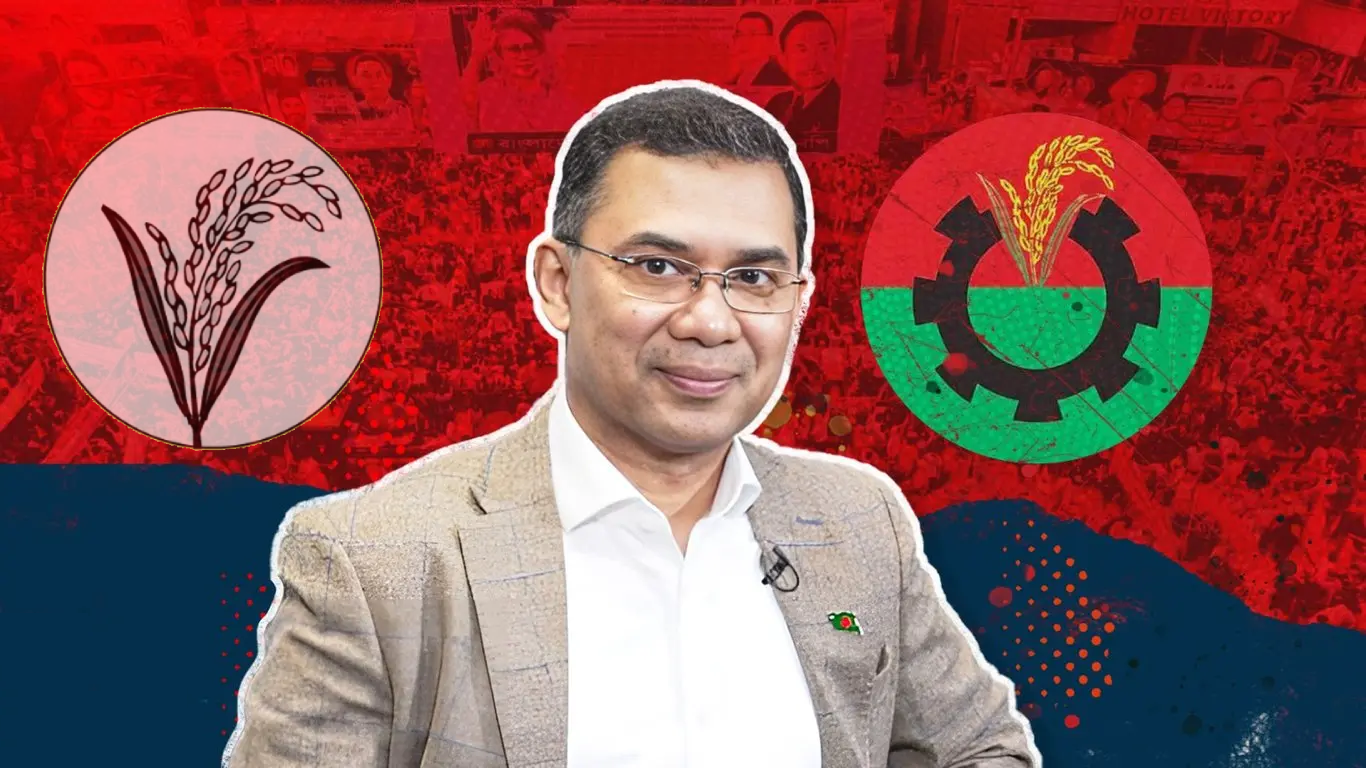
The Bangladesh Nationalist Party (BNP) is poised to form a majority government following a mass uprising. The party is returning to power after two long decades as it secured an absolute majority in the 13th parliamentary election. The Awami League, its old rival, was banned from the ballot.
The BNP has won 209 of the 299 parliamentary seats up for grabs in the election on Thursday. They now have the two-thirds majority they require in order to bring about changes to the Constitution through parliament.
The party is set to face Jamaat-e-Islami as the main opposition in parliament, although the partnership the two once shared now appears to belong to the past. Following the July Uprising, the Islamist party has emerged as a renewed force in Bangladeshi politics, winning 68 seats.
In addition to paddy sheaf candidates, candidates from BNP allies the BJP and Gonosamhati Andolon, and Gono Odhikar Parishad have picked up one seat each so far. Meanwhile, the Jamaat-led 11-party alliance has seen the National Citizen Party (NCP) win six seats, Bangladesh Khelafat Majlis two, and Khelafat Majlis one.
Apart from these two major alliances, Islami Andolan Bangladesh has picked up a solitary seat. Of the 50 parties that contested Thursday’s election, 41 – including the Jatiya Party, the opposition in the previous parliament – did not win a single seat. Independents won several seats.
The death of a candidate in the Sherpur-3 parliamentary race has resulted in the election being suspended. Once that election is complete, the 300-seat national parliament will be filled.
Alongside the parliamentary polls, voters also took part in a referendum on state reform, in which the “Yes” vote has won, as widely anticipated.
The result indicates public consent for implementing 48 points of constitutional reform included in the July National Charter.
The referendum, however, has drawn criticism over the process and the construction of the question, with concerns that many voters cast ballots without fully understanding what they were voting on.
TARIQUE’S POWER PLAY
Founded in 1978 by the late president Ziaur Rahman, BNP formed governments in 1991, 1996 and 2001 under the leadership of the late prime minister Khaleda Zia.
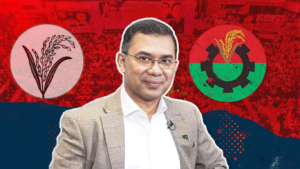
This time, it is their son, party Chairman Tarique Rahman, who is poised to lead it into government for a fourth term.
After the fall of military ruler Hussain Muhammad Ershad, the BNP returned to power in the 1991 election under Khaleda. In the three elections that followed, the party formed governments twice but completed a full term only once, before losing the 2008 election and leaving office.
During Awami League rule, the BNP boycotted two of three general elections and performed poorly in the third. The political landscape shifted after the July Uprising, which toppled the Awami League government and opened a path for the BNP’s return.
As the BNP returns to power after 19 years, its long-time rival of 35 years, the Awami League is not occupying the opposition benches. With its registration suspended and barred by the interim government following the Uprising, the party that has ruled Bangladesh for the longest time was unable to contest in the election after a decade and a half in power.
If Tarique assumes the premiership, taking up the baton from his mother, it will mark the end of a nearly three-decade duopoly at the centre of the country’s power matrix.
For much of that period, national politics revolved around his mother, the late BNP chairperson Khaleda, and Awami League chief Hasina.
Hasina, who ruled the country uninterrupted for nearly a decade and a half, now lives in exile in India following her ouster. Khaleda, the other former prime minister, passed away in December last year.
At different junctures, the two leaders alternated in office — one governing, the other leading the opposition from the streets.
International media once branded their entrenched rivalry as the “Battle of the Two Begums”.
The enmity deepened in 2004 when the Awami League blamed the then-BNP administration for a grenade attack aimed at assassinating Hasina.
Conversely, during the Awami League’s tenure, Khaleda faced imprisonment following a conviction in a corruption case.
Though she later secured a conditional release, her declining health effectively left her confined to her residence for years.
Following the fall of the Awami League government in the Uprising, Khaleda was fully exonerated and regained her freedom.
She, however, passed away on Dec 30 while battling severe illness, just weeks after the schedule for the Feb 12 vote had been announced.
The poignancy of her departure was captured by a grieving BNP activist, who lamented: “Oh Allah, if only she could have been kept alive for just a few more days, so my Madam could have witnessed this election before passing.”
With the Awami League excluded from the fray, the election saw participation from 50 parties, including the BNP, Jamaat, Jatiya Party, NCP, and Islami Andolan.
A total of 2,028 candidates, comprising both party nominees and independents, contested in the polls.
JAMAAT RISES AS MAJOR CONTENDOR
Jamaat, which has never won more than 18 seats in any election, has taken advantage of the altered landscape to mount a significant challenge to the BNP.
In addition, smaller parties allied with the BNP have also won seats, with BJP and Ganosamhati Andolon have each secured one.
Within the Jamaat-led 11-party alliance, NCP and Bangladesh Khelafat Majlis have won two seats each. Independent candidates have won three seats.
Full results are still pending in some constituencies, where BNP candidates are also ahead in several races.
PADDY SHEAF VERSUS WEIGHING SCALES
Tarique returned to the country after more than 17 years in self-imposed exile in London, receiving an enthusiastic welcome before launching his election campaign. After his mother’s death, he assumed the post of party chief and led the BNP through the election.
To strengthen its electoral position, the BNP reached seat-sharing arrangements with several partners from the anti-Awami League movement, leaving eight seats for them.
Tarique began campaigning on Jan 22 from the Alia Madrasah ground in Sylhet, holding rallies across the country. On the trail, he repeatedly attacked Jamaat-e-Islami and urged voters not to support a party he described as opposing the Liberation War and using religion for political ends.
Jamaat chief Shafiqur Rahman emerged as Tarique’s main rival. The party sought to project a new image during the campaign, while also drawing close to the LDP led by retired colonel Oli Ahmed and the youth-led National Citizen Party (NCP), whose leaders led the July Uprising. Jamaat also nominated a Hindu candidate.
Although Jamaat said it would uphold women’s rights if elected, controversy emerged during the campaign over remarks by its chief and other leaders about women.
The Jamaat chief traversed the length and breadth of the country to spearhead his party’s campaign.
Invoking the ghosts of the past, he took aim at the BNP’s record, pledging a draconian crackdown on “corruption and extortionists” should his party prevail.
During the 2001–2006 term, two Jamaat leaders were part of a BNP-led government. Yet the party has never formed a government on its own strength, nor even secured the position of principal opposition.
In the reshaped political landscape, it now appears closer than ever to altering that equation.
ELECTION DAY
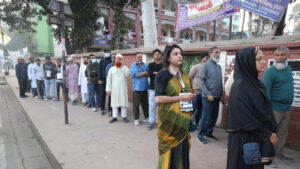
Eighteen months after the Uprising, the parliamentary election was held alongside a referendum on the July National Charter.
Voting in 299 constituencies ran from 7:30am to 4:30pm. The election in Sherpur-3 was suspended after the death of a Jamaat candidate during the campaign.
Overall, polling continued through the day largely peacefully, with no reports of major disruption. No centres were cancelled or halted.
During voting, six deaths were reported in Dhaka, Chattogram, Khulna, Manikganj, Brahmanbaria and Gaibandha. Five people reportedly died after suddenly falling ill, while there was an allegation of another death during an altercation between the BNP and Jamaat.
Visiting polling stations on election morning, Tarique expressed high hopes for a BNP landslide.
He indicated an intent to form a broad-based administration, governing alongside “most” political allies who stood by them during the movement.
After touring Adamjee School and College in Dhaka Cantonment, Mohakhali, Panthapath, Bhashantek, Manik Mia Avenue, Dhanmondi 27, and Sobhanbagh, he returned to his office to voice his satisfaction with the nationwide turnout.
“From what I have observed in Dhaka, it appears – Alhamdulillah — that people are casting their ballots with immense enthusiasm,” he said.
He noted that the surge of citizens returning to their ancestral homes via launches, steamers, trains, and buses over the last two days had set the stage for the high expectations he holds for the day’s outcome.
Shafiqur had sought to present the party in a new light during the campaign.
After casting his ballot at a centre at Monipur Uchcha Vidyalaya and College in the morning, he too expressed optimism about forming the next government.
“Through this vote, may a government be formed that belongs not to any person, family or party, but to 180 million people — a truly people’s government. We are hopeful. Pray for us,” he said.
Asked whether he saw any cause for concern over the polls, Shafiqur said: “If there are minor issues, we will ignore them. But if there are major issues, we will not let them pass. We will do what is necessary. We cannot allow people’s voting rights to be undermined.”
The Jamaat-led 11-party alliance alleged “disruptions” in voting at some centres in three constituencies. NCP said voting was “satisfactory” until noon, but that complaints later emerged around the country. Islami Andolan Bangladesh also raised allegations of irregularities.
The Election Commission, however, said no alarming situation had developed and that no centre had to suspend voting, while thanking citizens for participating in what it described as a festive environment.
At a polling centre at Dhaka University in the afternoon, the head of the European Union election observation mission, Ivers Ijabs, described citizens’ interest in voting as “positive”, citing information being received from observers around the country as the mission prepared a credible report.
Late on Thursday night, Jamaat chief Shafiqur alleged at an emergency press conference that returning officers in several constituencies were holding back results instead of declaring them, without providing details.
He said Jamaat believed it was ahead in several seats and that counting was complete, but results were not being announced, adding that some figures appeared on a website and were later removed.
In Dhaka-8, NCP candidate Nasiruddin Patwary went to the Dhaka Divisional Commissioner and Returning Officer’s office alleging that the results had been changed in favour of his BNP rival Mirza Abbas.
Later, Afroza Abbas, the BNP contender’s wife, went to the same office with counter-allegations.
Chief Advisor Muhammad Yunus congratulated the nation and expressed gratitude for what he described as a peaceful, orderly and festive election and referendum.
In a statement after polls closed, he praised voter participation, responsible conduct by political parties, restraint by candidates, and professionalism by election-related institutions.
He also thanked the Election Commission, law-enforcing agencies, the armed forces, the administration, observer teams, media workers and polling officials.
Yunus urged political parties and candidates to maintain democratic decorum, tolerance and mutual respect even after the final results are declared, stressing unity in the national interest.
Calling it a “great joy and festival”, he said the vote marked the beginning of an unprecedented journey for a “new Bangladesh”, and said that if the country can sustain this trend, democracy will reach a new peak.







+ There are no comments
Add yours