
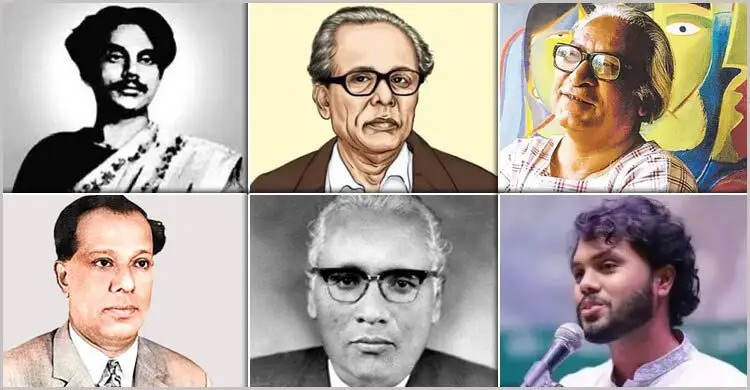
When Kazi Nazrul Islam, Bangladesh’s national poet, passed away on August 29, 1976, his final wish was honored. He had once said, “Bury me beside the mosque, so that even from the grave I may hear the call to prayer.” True to his words, he was laid to rest beside Dhaka University’s central mosque. Over time, that quiet resting place transformed into a national monument, a site of memory and reverence.
Yet Nazrul’s mausoleum is no longer only the poet’s eternal home. It has gradually become a sanctuary for other towering figures of Bangladesh’s cultural and intellectual life.
The Artist Who Painted a Nation
Close to Nazrul lies Shilpacharya Zainul Abedin, the pioneer of modern art in Bangladesh. His famine sketches and lifelong devotion to art education gave voice to the struggles and spirit of ordinary people.
The Designer of the BD National Flag
Nearby rests Kamrul Hasan, the celebrated artist who designed Bangladesh’s national flag. His bold strokes and uncompromising political art became symbols of resistance during the Liberation War.
The Scholars Who Shaped Education
Two former vice-chancellors of Dhaka University, Professor Abdul Matin Chowdhury and Muzaffar Ahmad Chowdhury, also found their final resting place here. Their contributions to academia and administration left a lasting imprint on the country’s higher education system.
A New Chapter of Memory
Most recently, on December 20, 2025, the mausoleum welcomed another figure: Sharif Osman Hadi, a youth leader whose death in political violence shocked the nation. His burial beside Nazrul has reignited public reflection on the mausoleum’s evolving role—not just as a poet’s grave, but as a collective shrine for Bangladesh’s conscience.
Today, the Nazrul Mausoleum stands as more than a burial ground. It is a tapestry of memory, where art, literature, education, and activism converge. Each grave tells a story of struggle and creativity, of voices that shaped the nation. Visitors come not only to honor Nazrul’s verses but to walk among the legacies of those who, in their own ways, dreamed of a freer, more enlightened Bangladesh.









+ There are no comments
Add yours